

The best nonprofit emails sound like they were written by one person to another.
Stop sounding like a press release and start sounding like a person, with eight steps and a ready-made schedule for Giving Tuesday and year-end.
Somewhere right now, a nonprofit executive director is staring at a blank email draft, typing and deleting the words "We hope this email finds you well." I know, because I've sat beside more than a few of them. It's never the cursor's fault. And it’s not your fault — you’re carrying a lot.
Here's what nobody tells you about email marketing for nonprofits: your donors aren't ignoring you. They're ignoring emails that sound like they were written by a committee, approved by a board, and sent by "The Team." Which, to be fair, many of them were.
Email is still one of the best tools a small nonprofit has. It's inexpensive, it's direct, and it lands in the one place most of your supporters check before their first cup of coffee. M+R's 2026 Benchmarks Study found that nonprofit email revenue grew 16% last year. But the same study found the average subscriber received 31 fundraising appeals and only nine newsletters. That's not a relationship. That's the friend who only calls when they need help moving.
The good news? Email marketing for nonprofits doesn't require a bigger team, fancier software, or a marketing degree. It requires a plan you can keep and the nerve to write like a human being. Below is the step-by-step process I walk clients through, plus a ready-made schedule for Giving Tuesday and year-end.
First, a quick reality check
According to M+R's Benchmarks, the average fundraising email gets a 0.59% click-through rate and a 0.05% response rate, raising about $54 for every 1,000 emails sent. Over a year, 12% of subscribers unsubscribe and another 4% bounce.
Translation: send a fundraising email to 1,000 people, and you typically get about six clicks and half a donation.
Two caveats. M+R studies mostly larger national organizations, and the benchmark that matters most is your own. But the lesson holds at any size: a single email is not a lottery ticket. Your list is a relationship, and you build relationships over many messages, most of which shouldn't ask for anything.
Step 1: Decide what your email is for
The biggest mistake I see in nonprofit email marketing is treating email as a fundraising channel that occasionally says hello. Flip it. Email is a relationship channel that also raises money.
Before you write anything, finish this sentence: Our emails help [who] feel [what], so they [do what]. For example: "Our emails help neighbors feel connected to the families we serve, so they give, volunteer, and tell their friends."
Then set a ratio. My rule of thumb outside campaign season: three emails that give (a story, an update, a thank-you) for every one email that asks. During Give to the Max, Giving Tuesday, and year-end, the asks get louder. That works because you've been generous all year.
Step 2: Clean your list before you write a word
A messy list is like a junk drawer. Everything technically lives there, and nobody can find the scissors.
Remove bounces. Your email platform does you the favor of flagging addresses that no longer work. Clear them out.
Re-engage the quiet ones. Find people who haven't clicked or given in 12 months or more. Send one honest "Still want to hear from us?" email, and let go of anyone who doesn't respond. I did this recently, and besides clearing out the clutter, it upped my open and click rates. Less isn’t always less; it’s sometimes more.
Find the missing people. Check your donor records against your email list. Recent donors who gave you an email address should be on it.
Never buy a list. People who didn't ask to hear from you don't want to hear from you. They'll prove it with the spam button.
Then sort what's left into a few simple groups. I covered this in depth in my post on donor segmentation, but four groups will get you through December:
Current donors: gave in the last 12 months
Lapsed donors: gave 13 to 36 months ago
Friends: volunteers, event guests, and subscribers who haven't given yet
Inner circle: board members, major donors, and close partners
Step 3: Set a rhythm you can keep
Consistency is the quiet superpower of email marketing for nonprofits. A monthly newsletter you send every month beats a weekly one you abandon by March. If your plan requires you to clone yourself, it isn't a plan. It's a wish.
A sustainable baseline for a small team is one newsletter and one story or impact email each month. Campaign season adds short bursts. Here's what that can look like this year, built on the campaign plan from October's post on Giving Tuesday and year-end. Giving Tuesday 2026 is Tuesday, December 1. Last year, Americans gave $4.0 billion on Giving Tuesday, up 13% from the year before, according to GivingTuesday.
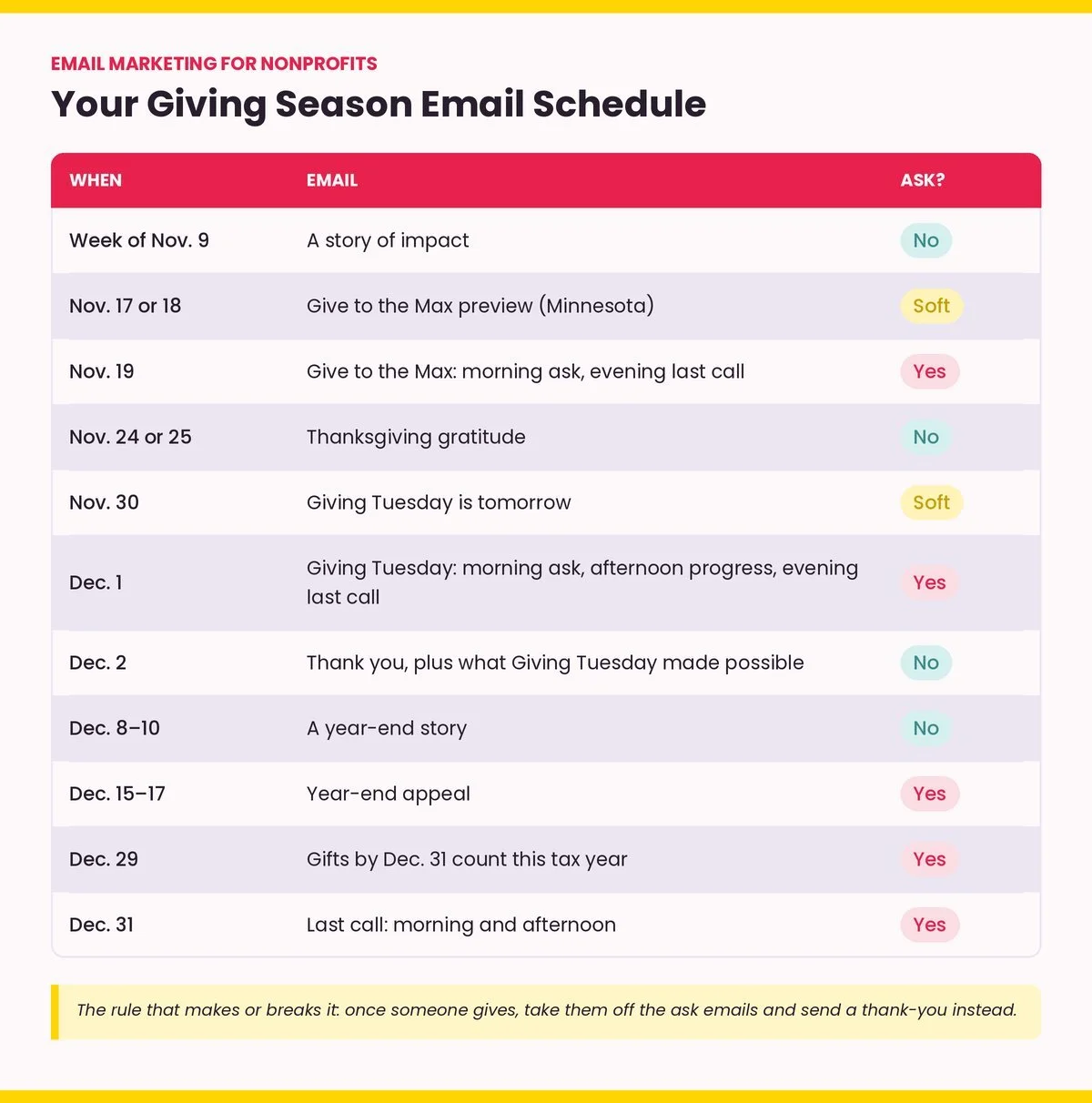
One rule makes or breaks this calendar: once someone gives, take them off the ask emails and send them a thank-you instead. Nothing says "we don't know you" like asking someone who gave this morning to give again this afternoon. Most email platforms let you exclude a group from a send. Set it up before November 19.
Step 4: Write subject lines like a person
The subject line is where nonprofit email marketing lives or dies. If yours could double as the title of a board report, try again.
Keep it short enough to read on a phone. Be specific. Lead with a person, a number, or a question, not your organization's name. Then use the preheader, the gray preview text after the subject line, to finish the thought. And send from a real person: "Kristin at Bright Futures" gets opened, while "Bright Futures Organization Inc." gets archived.
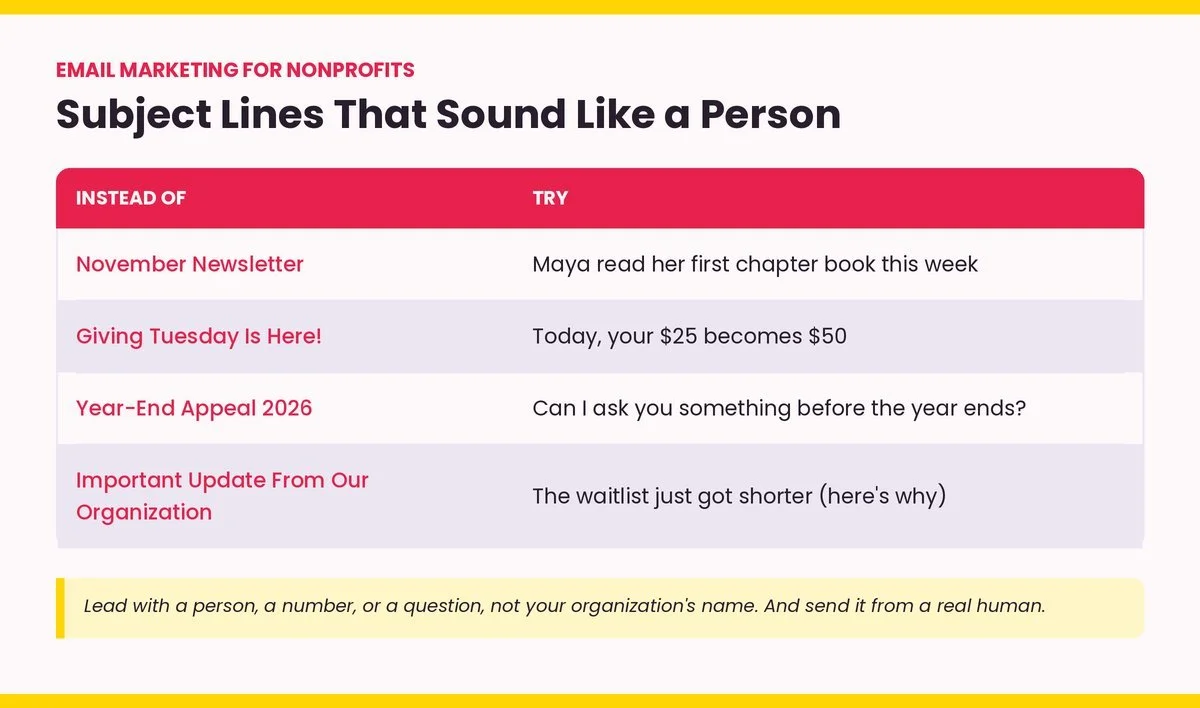
Full disclosure: every one of my subject lines starts with a ☀️ or 🌻. It's my brand, and I'm keeping it. Find yours.
Step 5: Write to one person
Picture one donor. Not "our valued supporters." One person, reading on her phone in the school pickup line. Then write to her.
Count your "you"s and "we"s. If "we" is winning, rewrite. Donors want to know what they made possible.
One story, one ask, one link. Every extra idea dilutes the one that matters.
Keep paragraphs to two or three lines. On a phone, a big block of text looks like homework.
Sign it from a human, and send from an address where replies get read.
Add a P.S. Readers often skip to it, so put your ask or your best line there.
Here's the difference in practice.
Before: "On behalf of the Board of Directors and staff, we are pleased to share that, due to the generosity of our supporters, we were able to expand programming in fiscal year 2026."
After: "Remember Jordan? Last spring, he was sleeping in his car. Today he has keys to his own apartment, and you helped hand them to him."
Same news. One version sounds like a person. If you're short on stories like Jordan's, February's post on building a Story Vault will help you fill the shelves.
Step 6: Make the button impossible to miss
Use one button with a verb that says what happens next: "Give $50 today" or "Send a kid to camp," not "Click here." Place it early, then repeat it at the end, pointing to the same page.
Then click your own button on your phone. The donation page should match the email's story and image, ask for as little information as possible, offer suggested amounts and a monthly option, and load quickly. Every extra form field is a speed bump. Enough speed bumps, and people turn around.
Running a Giving Tuesday match? A local business sponsor can double the urgency. Here's how to ask businesses for donations and get a yes.
Step 7: Measure what matters
The most misleading number in nonprofit email marketing is the open rate. Since Apple introduced Mail Privacy Protection in 2021, many "opens" are recorded automatically, whether or not anyone read a word. Treat opens as a rough signal at best.
Track these instead, in a simple spreadsheet with one row per email:
Clicks: did anyone take a next step?
Gifts and dollars: what did each email raise?
Replies: the most underrated metric there is. A reply means a relationship.
Unsubscribes: a spike after one email is feedback. Listen to it.
List growth: are you adding more people than you're losing?
Compare each email with your own past results, not someone else's. And if spotting patterns makes your eyes glaze over, the AI tools from September's post are good at exactly this.
Step 8: Automate the emails that should never be late
Here's the best part of email marketing for nonprofits: some of it can run while you sleep, walk the dog, or argue with your coworker about "that" versus "which."
Set up two automations once and let them work all year:
A welcome series for new subscribers: three emails over two weeks. The first says who you are with one great story, the second shows your impact, and the third invites them in, whether to give, volunteer, or follow along.
An instant thank-you for every online gift: warm, specific, and signed by a person. Then follow up personally within 48 hours. My post on donor thank-you letters has everything you need for that follow-up.
If you only do three things before Giving Tuesday
Clean your list, and set up the "already gave" exclusion.
Rewrite your next subject line and sign the email from a person.
Click your own donate button on your phone, and fix whatever annoys you.
That's it. That's the whole secret. Back to that executive director with the blinking cursor: delete "We hope this email finds you well." Type "Hi Pat, I wanted you to be the first to hear…" and keep going. That's email marketing for nonprofits: one person writing to another, many times a year, about something they both care about.
Coming next month
This post closes out a year-long series. Since February, we've built a Story Vault, turned annual reports into donor engagement tools, stretched one report into 90 days of content, asked local businesses for support, thanked donors well, segmented our lists, put AI to work, planned the giving season, and now written emails people want to open.
In December, I'll look back at what 2026 taught us about stories, donors, and the tools that tie them together, and share what's coming in 2027. If you'd like it in your inbox, subscribe to The Bright Bloom.
Need a hand with your inbox?
If you write emails at 9 p.m. the night before they go out, you're in very good company. I help nonprofits and small businesses build email programs that fit their time and team, plus content calendars for welcome series, campaign messaging, and the marketing planning that holds it together. If you'd like a second set of eyes on December's emails, let's talk.

